Retirement Architects Weekly Market Review: June 24, 2022

Weekly Market Report: June 24, 2022

We saw some typical bear market activity last week with equity markets continuing to churn, this time to the upside despite mounting evidence of a cyclical slowdown and global central banks chasing commodity prices. Some inflation data out of the U.K. and Germany provided some encouraging data points while other economic data made clear economies are still expanding, though at a decelerating pace. U.S. equity markets enjoyed a nice rally last week of over 6% while developed international (+3.75%) and emerging markets (+2.5%) were up but not as strong. Bond markets enjoyed further decline in interest rates while the USD lost a little ground and commodities, thankfully, did as well.

Market Anecdotes

• With the S&P 500 officially in a bear market, the key questions are how much deeper and how much longer? Depth and duration of the economic slowdown currently unfolding will be the determinant but either way, we’re on track for the worst six month start to a year since 1932.

• Wall Street analysts have been slow to adjust their year-end price targets for the S&P 500 with the S&P 500 now trading over 20% below its bottom-up consensus analyst price target – one of the widest divergences on record.

• Market and sentiment-based inflation expectations alongside inflation data continue to paint a concerning but mixed picture, particularly with a focus on headline data series.

• Some of the differences between CPI and PCE inflation include fixed versus dynamic weightings and differing data sources with the key differences in shelter and medical costs.

• Economists surveyed by The Wall Street Journal have dramatically raised the probability of recession, now putting it at 44% in the next 12 months, a level usually seen only on the brink of or during actual recessions.

• An interesting look at the origin of U.S. company profits from the BEA and Goldman Sachs does challenge some of the narratives of achieving adequate diversification by owning a broad basket of U.S. companies.

• A decoupling of U.S. consumer sentiment and unemployment has been one of the more remarkable reminders of the toxic power of inflation.

• With much attention on the health of the U.S. consumer due to the exceptional job market and household liquidity measures, it’s worth noting debt service on the part of corporations is also in a good position.

• Fossil fuel sales from Russia since their invasion of Ukraine have remained relatively stable but the composition has certainly changed and is expected to continue.

Economic Release Highlights

• Preliminary June PMI data saw broad based deceleration but remained in expansionary territory.
• U.S. Existing Home Sales for May (5.41mm) were down 3.4% last month and stand down 8.6% year over year.
• U.S. New Home Sales for May (696k) were up 10.6% over the prior month but are down 5.95% year over year.
• The average 30-year mortgage rate edged up to 5.81%, a level not seen since the advent of the global financial crisis in 2008.
• UofM Consumer Sentiment Index for June slid to 50.0, down from a 58.4 reading the prior month.

This communication is provided for informational purposes only and is not an offer, recommendation or solicitation to buy or sell any security or other investment. This communication does not constitute, nor should it be regarded as, investment research or a research report, a securities or investment recommendation, nor does it provide information reasonably sufficient upon which to base an investment decision. Additional analysis of your or your client’s specific parameters would be required to make an investment decision. This communication is not based on the investment objectives, strategies, goals, financial circumstances, needs or risk tolerance of any client or portfolio and is not presented as suitable to any other particular client or portfolio.
Secure Your Retirement

Retire With Tucker

Receive our market reports directly to your inbox.

303-734-1234

Retirement Architects Weekly Market Review: June 17, 2022

Weekly Market Report: June 17, 2022

Global central banks, inflation, and war in Ukraine combined to send equity markets to a second consecutive 5%+ decline as investors buckled up for a notable increase in the likelihood of recession. A primary driver was that the Fed made it pretty clear it had no intention of acknowledging financial conditions by stepping in to pause or ease or provide liquidity, unlike 1966 and 1987 – the only two bear markets on record that occurred without a recession in the general vicinity. Interest rates one year and shorter climbed 0.25% while maturities from 2yrs to 30yrs moved up a more modest 0.10%. Commodity markets fell 6% on the back of oil falling nearly 10% back to $109 and industrial metals were soft in reflection of global growth concerns.

Market Anecdotes

  • The Fed hiked interest rates by 75bps on Wednesday, above the 50bp rate hike plan it had telegraphed at its previous meeting and made clear their renewed focus on issues being presented by headline inflation. The FOMC dot plot projections were also revised sharply higher. 
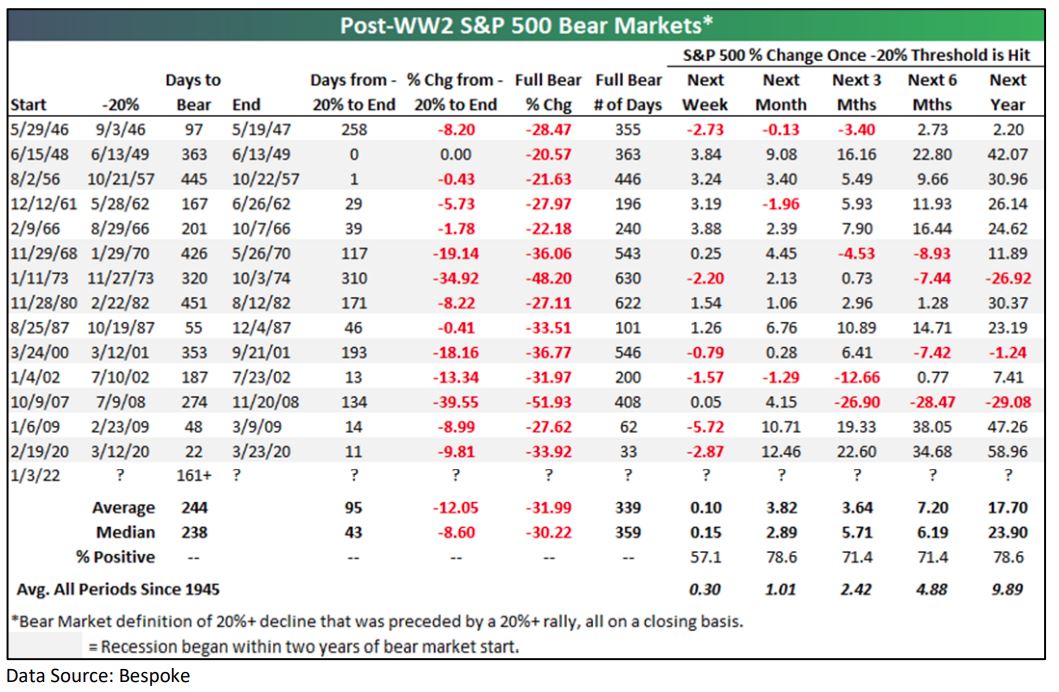
  • With ample red ink to swim in this week, we’ll note some green which is clearly evident in nearly all post WWII data showing equity market returns following bear markets, 15% quarterly drops, and 20% or worse six month drops. 
  • It’s been really rough sailing with nine of the last ten weeks closing out on a decline, something only three other periods can claim – 1970, 1982, and 2001. 
  • The year-to-date decline in S&P Growth of -30% versus S&P Value of -15% has brought their relative valuations quickly back into neutral territory and U.S. large caps (15.4x), U.S. mid-caps (11.1x), and small caps (10.8x) overall have fallen back into fair to cheap range. 
  • With inflation, and specifically the one including food and energy, now seemingly the focus of the Fed, the individual components and their trends warrant close attention. 
  • Recovery in U.S. labor market participation is a key underpinning to a more muted recession scenario potentially allowing payrolls to keep growing while the unemployment rate rises. 
  • Credit spreads in the bond market provide a good barometer of the overall economic anxiety level in the market and while high yield (above 5%) and investment grade (above 1.45%) are not yet at extreme levels, high yield CDS has risen to a new cycle high. 
  • Investor sentiment has fallen into extreme bearish territory with 19.4% bulls, 22.2% neutrals, and 58.3% bears while LEIs and industrial production and goods orders are showing the wear and tear of inflation. 
  • In an emergency meeting on Wednesday, the ECB pledged to “apply flexibility” when reinvesting PEPP proceeds and to address uneven impacts of policy normalization across jurisdictions. 
  • The BoJ stuck with its ultra-doveish policy keeping its target rate at -0.1% and reiterating its 10yr JGB target yield around 0% while the BoE hiked rates by 25bps as expected.
This communication is provided for informational purposes only and is not an offer, recommendation or solicitation to buy or sell any security or other investment. This communication does not constitute, nor should it be regarded as, investment research or a research report, a securities or investment recommendation, nor does it provide information reasonably sufficient upon which to base an investment decision. Additional analysis of your or your client’s specific parameters would be required to make an investment decision. This communication is not based on the investment objectives, strategies, goals, financial circumstances, needs or risk tolerance of any client or portfolio and is not presented as suitable to any other particular client or portfolio.
Secure Your Retirement

Retire With Tucker

Receive our market reports directly to your inbox.

303-734-1234

Retirement Architects Flash Memorandum: June 17, 2022

Flash Memorandum: June 17, 2022

On Wednesday of this week the Federal Reserve increased its benchmark federal funds rate by 0.75%, the largest single rate increase since 1994. The fed funds rate now stands at a range of between 1.5% and 1.75%. Fed officials expect the Fed to raise rates to at least 3% this year, with at least half of them indicating the fed funds rate may need to rise to 3.4% this year with rate hikes expected into 2023. Due to the clear connection between monetary policy and global economics and financial markets we feel compelled to provide clients with some insights and our current view of the landscape.

The Fed has seemingly changed its tone in recent days, taking a much more assertive stance toward bringing inflation down to its target level. This hawkish pivot is remarkable in that it appears to be driven by: 1) headline inflation and 2) a single monthly data point (the May CPI report released June 10th). These two elements represent a major deviation from 40 years of Fed policy. Historically the Fed has emphasized core inflation, and the trend thereof, which excludes the more volatile categories of food and energy prices. Changes in food and energy prices are more volatile and often related to temporary factors. For instance, environmental factors can influence agricultural commodity prices and fluctuations in OPEC production targets impacts energy prices in the near-term.
Both are examples of supply side stresses unrelated to trend changes in the economy’s overall price level and therefore not historically a material factor in monetary policy decisions.

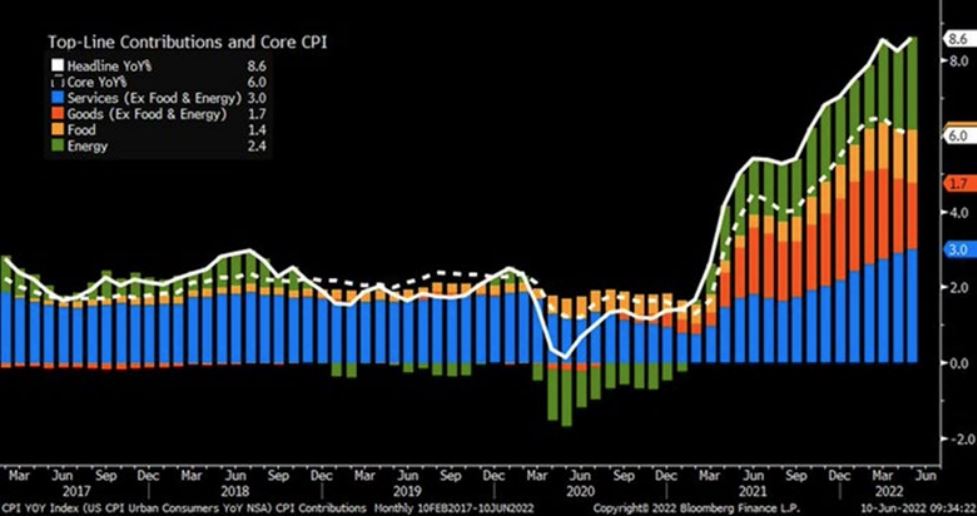
The image below shows the headline (all items) CPI index rising 8.6% for the 12 months ending in May, the largest 12-month increase since December 1981. The core (all items less food and energy) index rose 6.0% over the last 12 months, although it has fallen for the last two months including a decline from a 6.2% reading in April.

top-line-contributions-and-core-cpi

What does all of this mean and why is it important? Powell and his colleagues appear to be placing a larger focus on fighting headline inflation given trends in core data and narratives coming out of the Fed. Their preferred measure of core PCE has been declining since March.

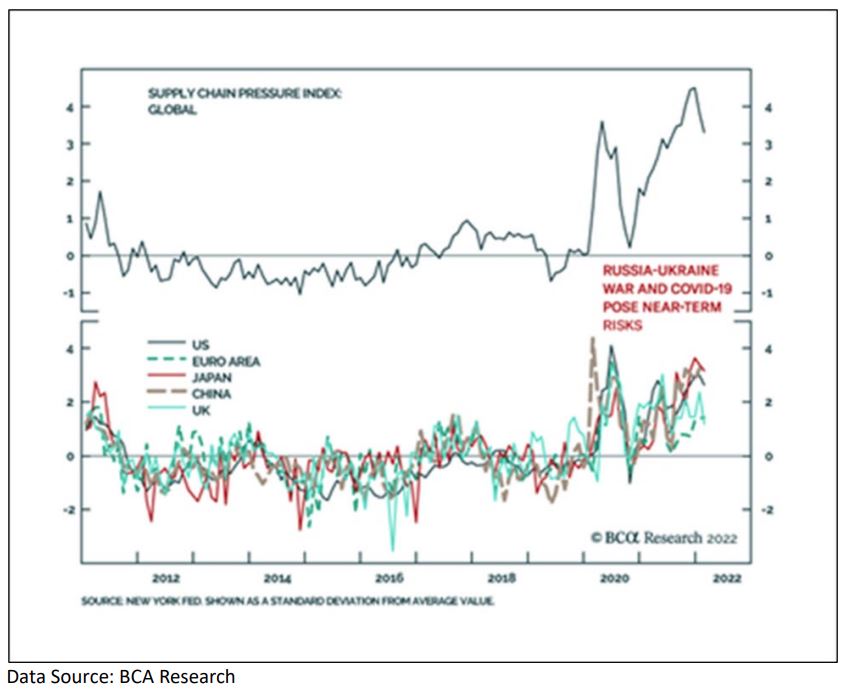
The Fed’s words and deeds suggest there is some tangible anxiety about the overall price levels and the perception that they have been well behind the curve. Powell blurred the concepts of core and headline inflation at his post FOMC press conference this week. As a result, markets are needing to factor trends in both headline and core inflation measures with a need for both to cool for the Fed to slow down the removal of accommodation. This will require food and energy prices to decline which are being driven overwhelmingly by the conflict in Ukraine. Supply side issues across commodity markets (grains and oil) need to begin to show healthier and improving trends for headline inflation to abate. 

supply-chain-pressure-index

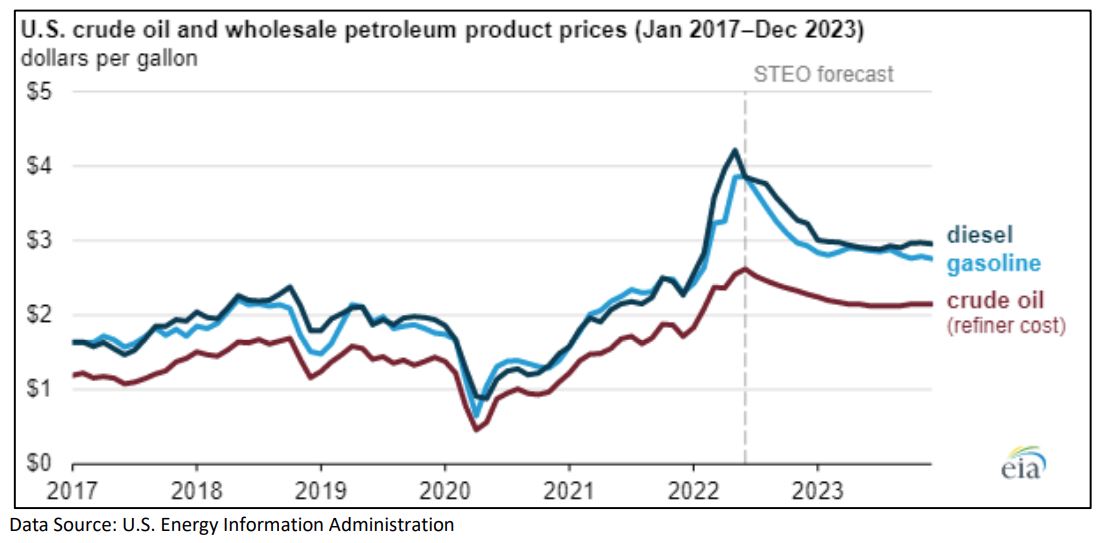
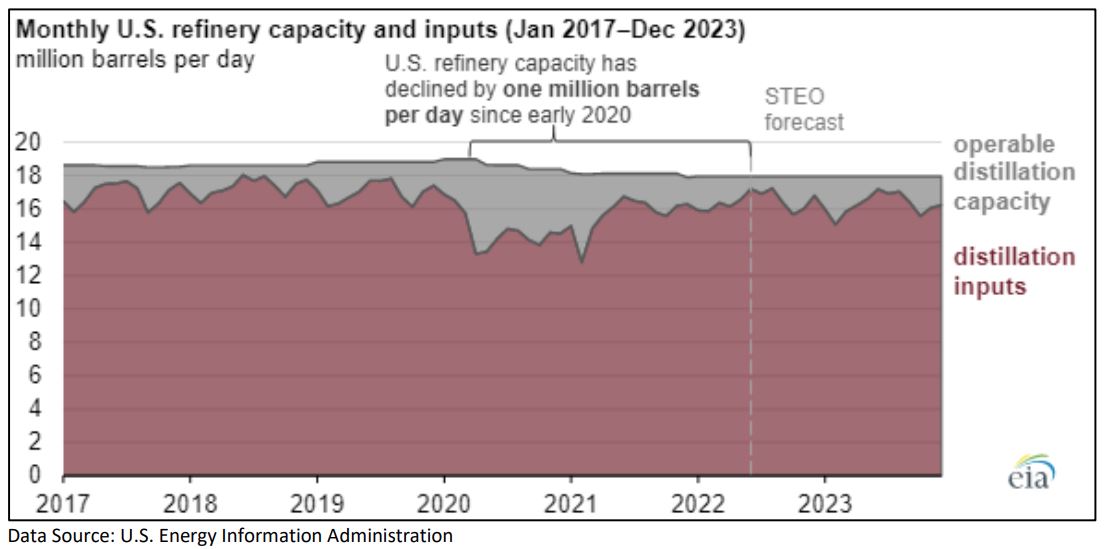
Increasing rig counts, refining capacity utilization, and energy alternatives to Russian oil need to materialize before the global economy weakens and unemployment begins to tick higher. Very elevated crack spreads have EIA expectations for an increase in refinery utilization to average 96% this summer is expected to take some pressure off gas prices but reduced overall refining capacity since the beginning of the pandemic has complicated the backdrop.

US-crude-oil-prices-2017-2023
monthly-us-refinery-capacity-and-inputs

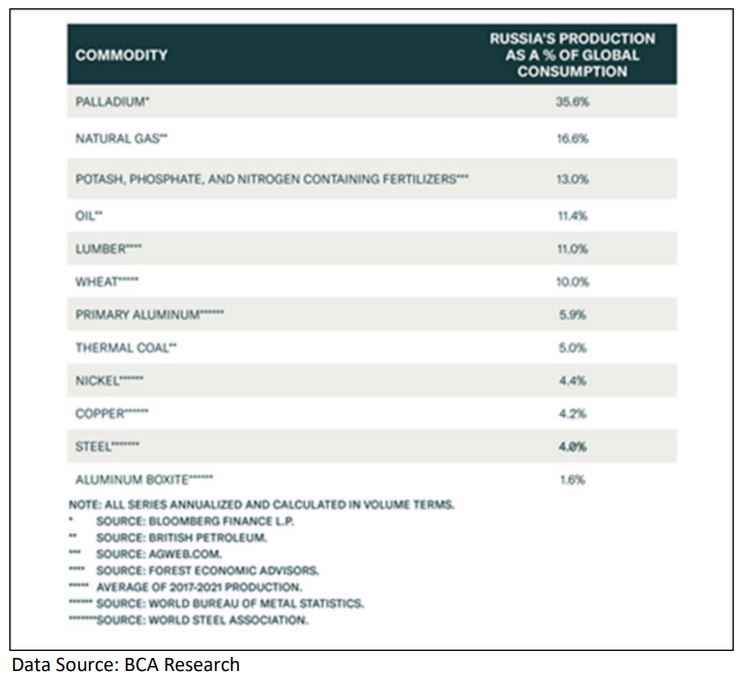
Additionally, Russia and Ukraine are both major exporters of wheat. The war has disrupted the normal farming and export cycles, driving wheat prices up more than 50% since a year ago. The prices of many other foods, ranging from grains to meats and oils have risen dramatically in recent months.

russian-commodities

Rising prices mean workers experience pay cuts when it comes to real wages. Even though average hourly earnings rose 0.3% in April, the net effect is a decline in real wages of 0.6% when accounting for inflation. On a 12-month basis, real average hourly earnings were down 3% in May.

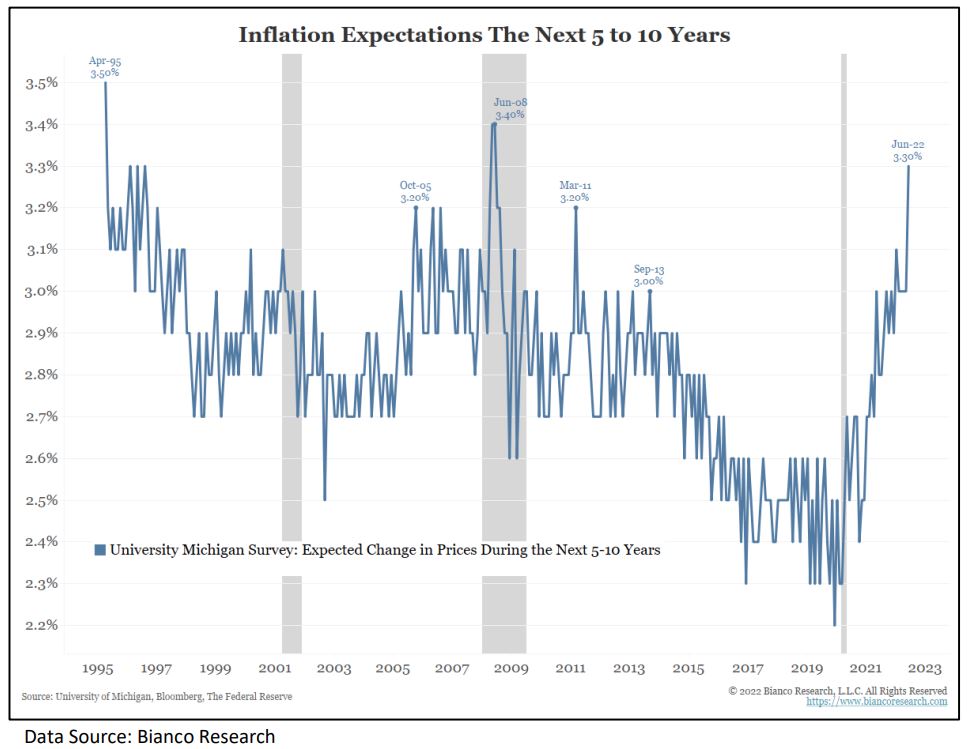
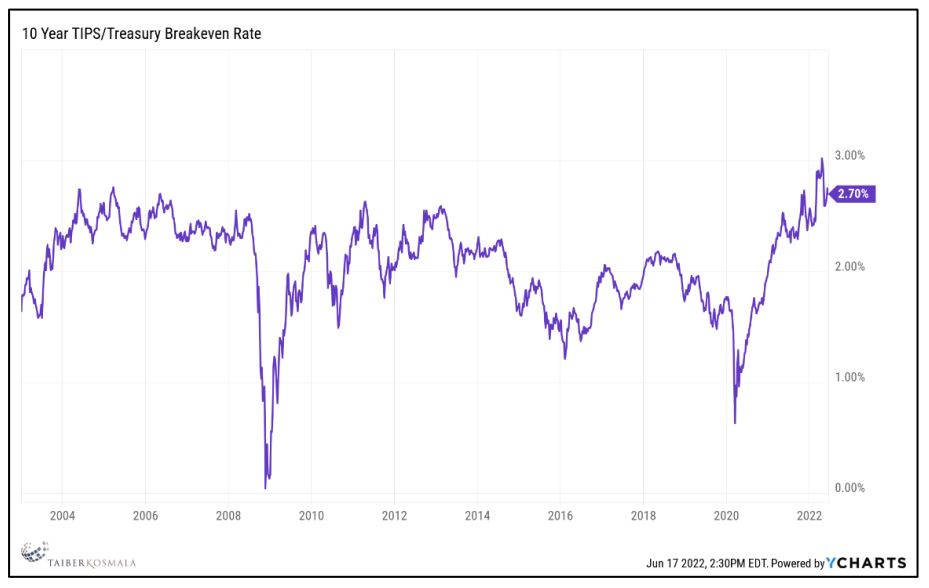
Although the market’s expectations for inflation (observable via TIPS break-even rates or 5-year forward inflation swaps) remain anchored at 3%, the University of Michigan Surveys of Consumers year-ahead inflation rate was 5.4%, up from 4.2% a year ago. The expectation for the next five years is 3.3% annually. This has clearly impacted Powell’s pivot to increasing hawkishness. Awareness of consumer sentiment becoming a major component of the Fed’s calculus suggests it needs to be scrutinized more closely by market participants, by extension. At his news conference, Powell said the Michigan survey helped push the central bank away from a 0.5% increase that had been expected only a week earlier. The Michigan Consumer Sentiment Index comes out twice each month, once in a preliminary reading, and then, two weeks later, in final form. The final Michigan reading this month comes out June 24th, two days after Powell presents his Monetary Policy report to the Senate Banking Committee. The Michigan survey is directly correlated with food and energy prices, essentially representing another pivot to headline inflation from core. 

inflation-expectations
10-year-TIPS

Finally, the trajectory of Federal Reserve rate hike forecasts this year have risen from 65 basis points in December 2021, to 175 basis points in March, to 341 basis points this week. It appears markets have lost confidence in the Fed’s forecasting abilities; hence, rate uncertainty and attendant equity volatility will persist until energy and food prices begin to decline.

As calendar year 2022 commenced, consumer balance sheets were strong, and savings abundant. Corporate revenues and profit margins were also vibrant. The market is clearly pricing in declining economic activity in the form of significant compression in P/E multiples because of the inflation backdrop and increasing central bank hawkishness. The S&P 500’s P/E multiple has compressed by about 22%, nearly equal to the decline in the index.

forward-pe-ratios-for-s&p-stock-price-indexes

Although recession indicators are still not flashing an imminent decline in economic growth, the odds of that occurring have risen in recent weeks. Given the Fed’s recent focus on headline inflation (which it cannot control outside of intentionally orchestrating a recession), the odds of them engineering the ‘soft landing’ have fallen,
leaving markets on edge.

There have been two bear markets in history which proceeded to fall notably after the initial ‘bear market’ 20%+ correction, 1973-1974 and 2008-2009. In both cases the U.S. economy fell into very deep and persistent recessions. If the Fed can engineer and maintain a modest economic backdrop as supply chains heal including supply side responses in both food and energy markets, equity markets (particularly emerging markets) are attractively priced when viewed over the intermediate term (1-3yrs) as the historical data below reminds us. That said, the bear market is here but potentially incomplete due to a likely decline in corporate profitability (rising rates, profit margins) and a persistent tax from high inflation.

postww2-sp500-bearmarkets

Bond yields probably overshot in the near term given the increased odds of recession which leads us to a moderately cautious stance on credit and neutral duration guidance from an interest rate risk perspective. In the end, trading in volatile markets is exceedingly difficult and should be minimized. Minor tactical rebalancing to maintain proper asset class exposures is advisable with equity markets now officially in bear market territory and bond markets off to their worst calendar year start on record.

Market Anecdotes

This communication is provided for informational purposes only and is not an offer, recommendation or solicitation to buy or sell any security or other investment. This communication does not constitute, nor should it be regarded as, investment research or a research report, a securities or investment recommendation, nor does it provide information reasonably sufficient upon which to base an investment decision. Additional analysis of your or your client’s specific parameters would be required to make an investment decision. This communication is not based on the investment objectives, strategies, goals, financial circumstances, needs or risk tolerance of any client or portfolio and is not presented as suitable to any other particular client or portfolio.
Secure Your Retirement

Retire With Tucker

Receive our market reports directly to your inbox.

303-734-1234

Retirement Architects Weekly Market Review: June 10, 2022

Weekly Market Report: June 10, 2022

Markets took another punch in the nose last week with inflation (CP-Oh My) and ensuing central bank policy the primary driver. Whether we are again looking at a sharp repricing or looming recession remains to be seen, but equity markets are seemingly handicapping the latter given the volatility and depth of the correction, currently 19% off the early January record high. Bond markets reacted sharply to the CPI print on Thursday with both yields and credit spreads surging late in the week. Broad commodity markets were flat on the week with oil edging up slightly to close over $120, grains rallied, and industrial metals down. The USD received a flight to quality bid late in the week, closing up nearly 2% to close at nearly a 20-year high.

Market Anecdotes

  • As if 2022 was short on breaking records, we’d note that we are on track so far this year to register one of the most volatile equity markets on record and one of one of the largest P/E multiple contractions on record, and without a doubt the worst start for the bond market ever. 
  • Bond markets again provided little solace last week with yields rising anywhere from 10bps to 40bps, mostly centered on shorter maturities, and a notable widening in credit spreads. 
  • Inflation anxiety was front and center last week with prices of energy and food, emanating purely from the RussiaUkraine war, driving both the number and sentiment. 
  • There has been anecdotal evidence of a pretty sharp recovery in the semiconductor supply chain situation across the auto sector with restored capacity happening far sooner than anticipated. Daimler Chrysler noted they are back operating at full capacity. 
  • ECB hawks finally got their way with Thursday’s announcement which set the table for a 25bps rate hike in July while remaining data dependent thereafter. They made significant upward revisions to their inflation forecasts (2022 5.1% to 6.8% and 2023 2.1% to 3.5%) and downgraded growth (2022 3.7% to 2.8% and 2023 2.8% to 2.1%). 
  • Rising interest rates translating to rising mortgage rates which have pushed the average 30 yr fixed rate back above 5.5% has seen demand for mortgages plummet and existing home prices fall but affordability and foreclosures still paint a constructive picture. 
  • A compelling way to look at the U.S. housing market is through a ‘two stage’ lens with higher mortgage rates softening demand followed by higher inventory and softening prices which would lead to a disincentive for home construction. 
  • BCA noted Russian energy weaponization may seek to disrupt oil supplies in the Middle East and North Africa as well as undermine attempts to restore the 2015 U.S.-Iran JCPOA. 
  • BCA noted Chinese credit data for May came in higher (better) than expected but it’s coming off an extremely low April reading and April/May combined are still below 2021 levels. 
  • In a small-cap vs large-cap research note, we’d note relative forward earnings growth, valuations, and relative performance in light of recession anxiety make a decent case for favoring small-cap.
This communication is provided for informational purposes only and is not an offer, recommendation or solicitation to buy or sell any security or other investment. This communication does not constitute, nor should it be regarded as, investment research or a research report, a securities or investment recommendation, nor does it provide information reasonably sufficient upon which to base an investment decision. Additional analysis of your or your client’s specific parameters would be required to make an investment decision. This communication is not based on the investment objectives, strategies, goals, financial circumstances, needs or risk tolerance of any client or portfolio and is not presented as suitable to any other particular client or portfolio.
Secure Your Retirement

Retire With Tucker

Receive our market reports directly to your inbox.

303-734-1234

Retirement Architects Weekly Market Review: June 3, 2022

Weekly Market Report: June 3, 2022

In a holiday shortened week, markets had to absorb a pretty full economic calendar and the usual dose of geopolitical and policy narratives. By week’s end, investors were left with a counterbalancing sense of slowing global growth crossed with strong job creation, wage gains, and consumer spending. Somewhat surprisingly, equity markets gave back only 1.2% of the prior week’s spectacular 6.6% gain. Bond yields firmly resumed their upward trend with yields climbing 15-25bps across the curve leaving the 10yr UST just shy of the psychological 3% level. Commodity markets continued to exhibit elevated volatility with oil closing up 3.3% to $118, within reach of March’s 14 year record high of $124.

Market Anecdotes

• Interest rates resumed their upward trend last week with a parallel move of nearly 20bps higher in what is still a solid positively sloping yield curve. The month of May wrapped up last week as the official worst YTD bond market on record.
• Aggregate S&P 500 EPS (12mo) of $134.90 is sitting at a record high and has increased 7% YTD priced at trailing and forward P/E multiples of 20.6x and 18.3x respectively. BCA Research made note that the 140bps rise in yields this year coincides with a 22% decline in forward P/E ratios.
• The AAII sentiment survey spiked last week with bullish reads surging from sub-20% to 32% and bearish reads plummeting 16% to 37%. The bull/bear spread, still pessimistic, narrowed to -5.1. Meanwhile, the Conference Board’s CEO confidence level here in 2Q has fallen sharply.
• An interesting ‘quality bias’ anecdote from Prudential last week regarding ‘zombie’ companies in the NASDAQ illustrates how 750 of Russell 3000 companies do not have sufficient earnings to cover interest expenses alone.
• A piece from BoA Merrill last week highlighted the historic record cash balances currently held on bank balance sheets to emphasize pronounced health and quality across the sector.
• While energy markets have continued to rip, metals and grains have reverted meaningfully off the initial ‘Russian invasion’ surge but are still in elevated territory when viewed historically.
• EU oil embargo details were released early last week, sending tremors through energy markets, but OPEC later surprised investors with an unexpected production increase to 648,000bpd in July and another increase in August which essentially restores all pandemic related production cuts.
• While the U.S. housing market has cooled in step with a 2% rise in mortgage rates, it doesn’t give us the sense of any looming issues. Affordability measures and mortgage rate spread to Treasuries provides an encouraging perspective when viewed long term.
• BCA pointed out the slowdown in their Global Leading Economic Index confirms slowing global growth momentum, but the diffusion index appears to have bottomed and is shifting higher.

This communication is provided for informational purposes only and is not an offer, recommendation or solicitation to buy or sell any security or other investment. This communication does not constitute, nor should it be regarded as, investment research or a research report, a securities or investment recommendation, nor does it provide information reasonably sufficient upon which to base an investment decision. Additional analysis of your or your client’s specific parameters would be required to make an investment decision. This communication is not based on the investment objectives, strategies, goals, financial circumstances, needs or risk tolerance of any client or portfolio and is not presented as suitable to any other particular client or portfolio.
Secure Your Retirement

Retire With Tucker

Receive our market reports directly to your inbox.

303-734-1234

Retirement Architects Monthly Market Review: May 2022

May Market Review

The market narrative in May transitioned to a debate on whether we are looking at recession or repricing debate; both nine letters, both look kind of similar, but are fundamentally very different beasts. In the end, May added to the 2022 legacy of heightened equity market volatility, geopolitical uncertainty, and sizable monetary policy influence. As expected, the Fed raised its policy rate 50 basis points in May and underscored its desire for similar 50 bp hikes over the next two meetings with the intent to keep tightening financial conditions until clear and convincing data of slowing inflation emerges. They are certainly not alone in their intent to eliminate emergency levels of policy accommodation with the ECB, BoE, and many other central banks moving the same direction. From a fundamental perspective, corporate profit growth is reverting to sustainable levels, inflation is running persistently high, the job market remains very healthy, and overall service and manufacturing sector activity is expanding. Overall, it’s been a very challenging year with markets on pace for record levels of volatility and virtually all financial assets (stocks and bonds) struggling. U.S. and most international equity markets flirted with bear market territory mid-month before recovering over 8% in the final six trading days. May saw continued dispersion within global equity markets with some areas doing particularly well (value, small caps, international developed markets, Latin American, and energy stocks) and some not so much (growth stocks, REITs, Eastern Europe). While the S&P 500 notched a 0.2% gain on the month, year to date it is down 12.8%, international stocks are down 11.3% (-4.9% in local currency terms), and emerging markets are 11.7% lower. May did break a streak of five consecutive down months in the bond market, returning 0.6%, but still have not provided much shelter with broad U.S. bonds down approximately 9%, non-U.S. bonds -14.5%, municipal bonds losing 7.5%, and high yield bonds off 8% year to date – numbers which place 2022, through May, as the worst performing bond market on record with data going back to the early 1970’s. Commodity markets continued their advance with a 1.5% in May thanks to the energy complex (+10.4%) continuing its rally on the back of Russian-Ukraine global supply concerns while industrial metals lost ground on global growth slowdown concerns.

Market Anecdotes

  • Aggregate S&P 500 EPS (12mo) of $134.90 is sitting at a record high and has increased 7% YTD priced at trailing and forward P/E multiples of 20.6x and 18.3x respectively. BCA Research made note that the 140bps rise in yields this year coincides with a 22% decline in forward P/E ratios. 
  • Earnings, dividends, and multiple expansion/contraction are the drivers of stock market returns and the latter has both giveth (2020-2021) and taketh (2022) in grand fashion in recent years. • The headwind of high and rising bond yields has relented recently giving higher P/E stocks some breathing room and increasing the number of modestly priced stocks, particularly in non-U.S. markets.
  • Q1 GDP revision, from -1.4% to -1.5%, came with a strong upward revision to personal consumption spending which was offset by lower private inventory investments. Growth of 3.9% and an upward trend in sales to domestic purchasers signals healthy GDP for Q2.
  • Robust consumer balance sheets (demand) support a constructive view of forward growth expectations with $4t in checking and loose currency and $4.5t in money market holdings.
  • BCA pointed out the slowdown in their Global Leading Economic Index confirms slowing global growth momentum, but the diffusion index appears to have bottomed and is shifting higher.
  • While the U.S. housing market has cooled in step with a 2% rise in mortgage rates, it doesn’t give us the sense of any looming issues. Affordability measures and mortgage rate spread to Treasuries provides an encouraging perspective when viewed long term.
  • EU oil embargo details were released early last week, sending tremors through energy markets, but OPEC later surprised investors with an unexpected production increase to 648,000bpd in July and another increase in August which essentially restores all pandemic related production cuts.
  • China’s weak housing market, zero tolerance Covid policy, and weakening global  manufacturing demand has begun to influence policy with the PBoC lowering its 5yr loan rate by 15bps following a rate cut in the mortgage market in May.
This communication is provided for informational purposes only and is not an offer, recommendation or solicitation to buy or sell any security or other investment. This communication does not constitute, nor should it be regarded as, investment research or a research report, a securities or investment recommendation, nor does it provide information reasonably sufficient upon which to base an investment decision. Additional analysis of your or your client’s specific parameters would be required to make an investment decision. This communication is not based on the investment objectives, strategies, goals, financial circumstances, needs or risk tolerance of any client or portfolio and is not presented as suitable to any other particular client or portfolio.
Secure Your Retirement

Retire With Tucker

Receive our market reports directly to your inbox.

303-734-1234